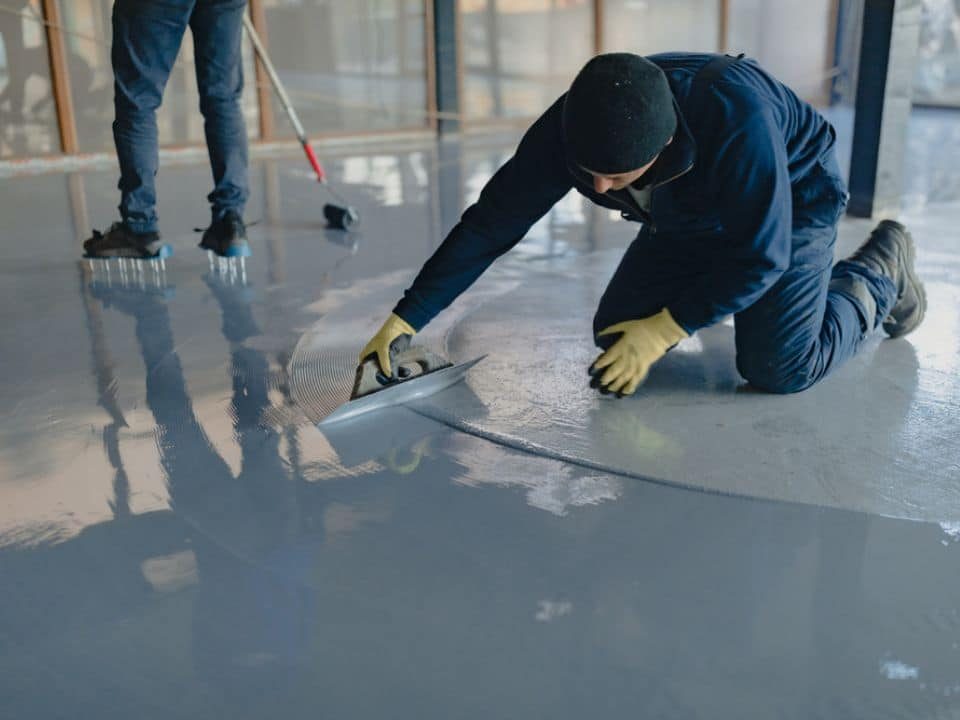
Protect worn concrete against moisture, chemicals, and everyday wear while refreshing its look.
Enter your info below and we'll follow up fast.
Concrete is naturally strong, but it isn't indestructible. Heavy traffic, vehicle weight, and Central Texas weather swings, from intense summer heat to occasional winter freezes, take a toll over the years. Add in San Marcos's expansive clay soil, which shifts with moisture changes, and it's easy to see why local floors are prone to cracking, staining, or a worn appearance sooner than in other parts of the country.
A coating turns a dull, stained floor into something sleek and well-cared-for, with a wide range of colors, finishes, and patterns available. Coatings also add real durability, resulting in less maintenance and fewer repairs, and the resulting surface is easier to clean and sanitize, a benefit that matters in commercial kitchens or medical facilities.
Four different treatments get grouped under “concrete floors,” and they are not interchangeable. Knowing which one fits your slab saves money and avoids a finish that disappoints.
Polished concrete uses no added material at all. We grind the existing slab through progressively finer diamond abrasives, then apply a chemical densifier that hardens the surface from within. The result is the slab itself, made smooth and reflective. It is the most durable option available, it never peels because there is no separate layer to peel, and it suits retail floors, warehouses, and modern residential spaces. The tradeoff is that you get whatever color and character the original concrete has, including old patches and stains.
Concrete staining adds color without adding thickness. Acid stains react chemically with the slab to produce mottled, variegated tones, while water-based stains give more predictable, uniform color. Stains penetrate rather than coat, so they need a sealer on top and they will not hide surface damage.
Sealers are thin, largely invisible, and mainly repel moisture and stains. They cost the least and last the shortest time, typically a few years before resealing.
Coatings, including epoxy and polyaspartic systems, build a genuine new surface on top of the slab measuring anywhere from 20 to 40 mils thick. This is the option that hides imperfections, delivers a specific color you choose, and stands up to chemicals and vehicle traffic. If your concrete is stained, patched, or unattractive and you want it to look deliberately finished rather than raw, a coating is the answer.
Grinding, cleaning, and removing existing coatings or debris so the surface is clean and properly profiled.
Inspecting for and repairing cracks, especially important given clay soil movement in San Marcos.
Applied in carefully timed layers, adjusted for temperature and humidity.
Full cure time is respected, since rushing compromises strength and appearance.
A thorough walkthrough and any necessary touch-ups before the job is complete.
A clean, straightforward finish that's easy to maintain.
A more decorative, dimensional look for garages, showrooms, and businesses.
A smooth, glossy finish achieved by grinding and sealing the existing slab, popular for commercial and retail spaces.
The single most common cause of coating failure is moisture moving up through the slab. Concrete is porous, and a slab poured on grade draws water vapor from the soil beneath it continuously. When that vapor reaches a coating it cannot pass through, pressure builds underneath and the coating bubbles, blisters, or lifts away in sheets, sometimes a year or two after a job that looked flawless on day one.
This matters more here than in drier climates. Hays County sits on expansive clay that holds water, swells after rain, and shrinks in drought. Many San Marcos homes built before the 1990s have no vapor barrier under the slab at all, and older commercial buildings along the I-35 corridor often do not either.
We test before quoting a system, not after. A calcium chloride test measures how much moisture passes through a given area over three days, and a relative humidity probe reads conditions inside the slab itself. If the readings come back high, we specify a moisture-mitigating primer or a vapor-barrier coating rated for those numbers rather than applying a standard system and hoping. It adds a step to the schedule. It also prevents the failure that forces a complete grind-off and redo.
Real strength added for resistance to cracking, staining, and everyday wear from heat and soil movement.
A wide range of colors, finishes, and patterns to match your style or space.
Slip-resistant texture options add safety in garages, patios, and commercial spaces prone to spills.
A coating can smooth minor surface imperfections, but significant unevenness may need leveling or patching first. We assess this during your consultation.
Yes, we offer UV-stable systems suited for patios and other exterior applications that withstand direct San Marcos sun.
A sealer is a thin, largely invisible layer, while a coating is a much thicker, more durable system that changes both the look and performance of the floor.
Most concrete coating projects cost $3-$12 per square foot installed, depending on the chosen system, slab condition, and square footage. We provide a real number after a free on-site assessment.
In most cases, the old paint needs to be ground off first so the new coating can properly bond. We assess this during your free consultation.
Light foot traffic is usually fine within a day, but we recommend waiting several days before driving or placing heavy equipment on the surface while it fully cures.
Not always. Polishing requires multiple grinding passes with progressively finer diamond tooling, which is labor-intensive, so a high-gloss polish on a slab in poor condition can cost more than a solid-color coating. Polishing tends to win on cost over a twenty-year horizon because there is nothing to recoat.
Fresh concrete needs roughly 28 days to cure before any coating goes down, and we still moisture test at that point. New slabs release a great deal of water vapor early on, and coating too soon is one of the most reliable ways to cause a bubbling failure later.
A densifier is a liquid silicate that soaks into concrete and reacts with the free lime inside it, hardening the surface and reducing dusting. It is standard in a polished concrete system and useful on soft or dusty slabs. It is not a substitute for a coating, since it adds no color and no measurable thickness.
Yes, but the old sealer has to come off first. Coatings bond to open concrete pores, and a sealer is specifically designed to close them. We diamond grind the slab to remove the previous sealer and open the profile so the new system adheres properly.
Larger areas generally lower the per-square-foot cost because mobilization and setup are spread across more footage. A 5,000 square foot warehouse floor usually prices lower per foot than a 400 square foot utility room. Slab condition, required downtime, and whether work has to happen after hours all factor into the final number.
Most concrete coating work in the San Marcos area runs $3 to $12 per square foot installed. That is a wide band, and where a specific floor lands depends on three things more than anything else.
Slab condition drives the biggest swing. A sound, clean slab needs grinding and not much else. A slab with spalling, deep cracks, old adhesive, or a failed previous coating needs repair work before the new system goes down, and that preparation is genuine labor.
System choice comes next. A single-color epoxy sits at the lower end. Polyaspartic systems cost more per gallon but cure fast enough to return a commercial floor to service in a day, which often pays for itself in avoided downtime. Decorative flake and metallic finishes add material and application time.
Moisture mitigation, when testing shows it is needed, adds a primer layer and its own cure window. It is not an upsell we apply by default, and the test results tell us plainly whether your slab calls for it.
We quote after walking the space, not before. An honest number requires seeing the concrete.